Category Archives: News

E70C-6M Seamless Metal-Cored Wire: Features, Applications, and Why European Fabricators Are Replacing Solid Wire

Introduction

Walk into any modern European fabrication shop and you will see the same pressure: weld more metres per shift, reject fewer parts, keep fume levels under tight occupational limits, and still hit the mechanical properties required by EN ISO and CE-marked structures. For mild and 490 MPa-class high-tensile steel, one consumable has quietly become the default answer to all of those demands at once: E70C-6M seamless metal-cored wire.

In this article we explain what E70C-6M actually is, what makes it different from a conventional solid GMAW wire, where it is used, and — importantly — why European fabricators in particular are replacing solid wire with it.

What Is E70C-6M Seamless Metal-Cored Wire?

E70C-6M is an AWS A5.18 / A5.18M classification for a gas-shielded, metal-cored electrode used with the GMAW (MIG/MAG) process. It is often described as sitting between solid wire and flux-cored wire:

  • Solid wire is a drawn, homogeneous alloy rod.
  • Flux-cored wire has a metallic sheath filled with fluxing and alloying powders, and leaves a slag.
  • Metal-cored wire has a metallic sheath filled with metallic powders and alloying elements only — essentially no flux. It produces little or no slag, but keeps the high-productivity arc behaviour of a cored product.

“Seamless” refers to the manufacturing route: the sheath is formed and closed without a longitudinal seam, which improves feedability through long conduit liners and robotic torches, reduces moisture pickup, and gives a more consistent current path.

Typical classification data for E70C-6M (H4 variant):

Property Typical requirement / value
AWS classification E70C-6M (often E70C-6M H4)
Process GMAW / GMAW-C, gas-shielded
Polarity DC electrode positive (DCEP)
Shielding gas Argon-rich blends, e.g. M21 (≈80% Ar / 20% CO₂) or M20
Yield strength (0.2% offset) ≥ 400 MPa (58 ksi)
Tensile strength ≥ 480–490 MPa (70 ksi)
Elongation ≥ 22%
Diffusible hydrogen (H4) ≤ 4 ml/100 g
Common diameters 0.9, 1.0, 1.2, 1.4, 1.6 mm

The “H4” suffix matters in European heavy fabrication because low diffusible hydrogen reduces the risk of hydrogen-induced cold cracking on thicker and higher-strength steels.

Key Features of E70C-6M

1. High deposition rate and travel speed

Because welding current is concentrated in the outer metallic sheath rather than distributed across a full solid cross-section, metal-cored wire runs at higher current density for the same diameter. The result is a spray or pulsed-spray transfer with high melt-off — typically noticeably higher deposition rates (kg of weld metal per hour) than an equivalent solid wire. For fabricators, that directly translates into fewer passes and faster cycle times.

2. Stable, soft arc and very low spatter

E70C-6M is formulated for a smooth, stable arc with fine droplet transfer. In practice this means less spatter, fewer post-weld grinding and cleaning operations, and a better bead appearance — especially useful on visible structural welds and on parts that will be painted or coated.

3. Minimal slag, almost no interpass cleaning

Unlike flux-cored wires, a metal-cored product contains essentially no slag-forming flux. The weld bead is slag-free or near slag-free, so interpass chipping and wire-brushing are largely eliminated. On multi-pass fillet and groove welds this is one of the biggest hidden labour savings.

4. Wide, bowl-shaped penetration and good gap bridging

The concentrated current in the sheath produces a broader penetration profile and better sidewall fusion than solid wire, and the arc tends to bridge minor root gaps and fit-up variations. This makes E70C-6M forgiving on less-than-perfect joint preparation — a common reality in structural and heavy-equipment shops.

5. Tolerance of less-than-pristine base material

The alloyed metal core helps the weld pool handle light rust, mill scale and oil residues better than a plain solid wire. It is not a substitute for proper cleaning, but it reduces the risk of porosity and lack-of-fusion on “semi-clean” production steel.

6. All-position capability with pulse

Smaller diameters (typically up to 1.2 mm) can be run in all positions with pulsed or short-arc transfer, while larger diameters are normally used in flat and horizontal fillet positions. That flexibility lets one consumable cover robotic flat-position cells and manual out-of-position work on the same project.

7. Low hydrogen and good toughness

The H4 variant keeps diffusible hydrogen low, and properly formulated E70C-6M deposits deliver good Charpy V-notch toughness at sub-zero temperatures (for example meaningful values at −30 °C to −40 °C depending on the product and shielding gas). This is valuable for outdoor structures, bridges and equipment operating in Northern European climates.

Typical Application Scenarios

E70C-6M is specified wherever mild steel or 490 MPa-class high-tensile steel is joined under productivity pressure. Common applications include:

  • Structural steel fabrication — buildings, stadiums, industrial frames, EN 1090 CE-marked structures.
  • Heavy equipment and machinery — excavators, cranes, agricultural machinery, mining equipment.
  • Shipbuilding and offshore — deck structures, stiffeners, secondary structural welds.
  • Bridges and civil engineering — girders, cross-beams, field and shop fabrication.
  • Automotive and transport — chassis, trailers, truck bodies, hot-water tanks and thin-to-medium section components.
  • Robotic and automated cells — the seamless sheath feeds reliably through long torches and conduit, and the stable arc tolerates the long, uninterrupted runs that robots demand.
  • Pipeline and pressure-vessel work — selected grades are used for fill and cap passes on pipeline steel and pressure-vessel fabrication, subject to procedure qualification.

In short: if the joint is carbon steel, the volume is meaningful, and spatter/clean-up/rework are costing money, E70C-6M is usually a candidate.

Why European Fabricators Are Replacing Solid Wire

The switch is not happening because solid wire is bad — it is happening because in the European cost and regulatory environment, the economics of metal-cored wire are unusually compelling.

1. Labour is the dominant cost, not the wire

In European fabrication, labour typically accounts for the large majority of total welding cost, while filler metal is a small fraction. A consumable that costs more per kilogram but lets the welder deposit more metal per hour, grind less, and rework less will almost always reduce total cost. E70C-6M’s higher deposition rate and near-zero slag clean-up map directly onto that equation.

2. Tight occupational fume and carcinogen rules

The EU operates under the Carcinogens and Mutagens Directive (2004/37/EC) and supporting standards such as EN ISO 15011 (fume and gas emission measurement) and EN ISO 15012 / EN ISO 21904 (extraction equipment). Welding fume is treated seriously, and exposure limits for constituents such as hexavalent chromium and nickel compounds are stringent. While metal-cored wire still produces fume, its stable spray transfer and low-spatter behaviour generally produce less particulate per kilogram of deposited metal than a comparable short-circuit solid-wire process, and it is easier to capture at source with extraction hoods. For employers carrying out mandatory risk assessments, that is a meaningful lever.

3. CE marking and EN ISO quality consistency

Structural steel placed on the EU market under EN 1090 must be CE-marked, with welding executed according to approved WPSs and supervised by certified welding personnel. E70C-6M deposits with consistent, well-documented mechanical properties and low hydrogen make procedure qualification and production control more predictable. The broad penetration profile also reduces the risk of hidden lack-of-fusion defects that only show up in NDT — an expensive failure mode in CE-audited fabrication.

4. Automation and robotic welding are widespread

European industry has invested heavily in robotic and fixed-automation cells. Seamless metal-cored wire feeds more reliably through long robotic torches and conduit, and its forgiving arc handles the steady, high-duty-cycle runs that robots produce. Once a cell is qualified on E70C-6M, the productivity gain compounds across thousands of identical parts.

5. Energy and material efficiency

Higher deposition rates and fewer passes mean less arc-on time per joint, which reduces energy consumption and heat input — helpful for distortion control on thinner sections. Less spatter and slag also mean less filler metal wasted as clean-up scrap and less consumable consumed per metre of acceptable weld.

6. Workforce and skill pressures

With a shortage of experienced welders across much of Europe, a forgiving, easy-to-run consumable that tolerates minor fit-up variation and produces a clean bead is a real asset. It reduces the gap between a highly skilled welder and a less experienced operator on repetitive production work.

Practical Considerations Before Switching

E70C-6M is not a drop-in magic replacement. Before qualifying it on a production job, keep the following in mind:

  • Shielding gas is mandatory. Unlike self-shielded flux-cored wire, metal-cored wire always needs an external shielding gas — normally an argon-rich M20/M21 blend.
  • Wire cost per kilogram is higher. The business case rests on labour and productivity savings, not on filler-metal price. Run a deposition-rate and clean-up trial before deciding.
  • Re-qualify your WPSs. Changing from solid to metal-cored wire is a change of consumable type and will require welding procedure qualification under EN ISO 15614 (or an approved equivalent) before it can be used on CE-marked work.
  • Set parameters correctly. Metal-cored wire runs best in spray or pulsed spray; short-circuit settings designed for solid wire will not give the expected deposition or bead shape.
  • Storage matters. Even seamless cored wire should be kept dry and within the manufacturer’s recommended conditions to protect the low-hydrogen rating.

Conclusion

E70C-6M seamless metal-cored wire combines the slag-free, clean behaviour of solid GMAW wire with the high deposition rate, stable arc and forgiving penetration of a cored product. For mild and 490 MPa-class steel, it delivers a strong all-round package: high travel speed, low spatter, minimal interpass cleaning, good gap bridging, all-position flexibility with pulse, and low-hydrogen deposits with reliable toughness.

For European fabricators, the case is particularly strong because the region’s high labour costs, strict fume and carcinogen regulations, CE-marking quality requirements, and widespread automation all favour a consumable that reduces arc-on time, clean-up and rework while keeping properties and exposure under control. Solid wire will not disappear — it remains the right choice for many thin-section, short-arc and general-purpose jobs — but on medium-to-heavy carbon-steel fabrication, E70C-6M has become the productivity upgrade that pays for itself.

If you are evaluating a switch, the next step is a side-by-side deposition and clean-up trial on one of your actual joints, followed by WPS qualification. That is the only number that matters: how much does it cost you to produce one acceptable metre of weld, end to end.
Seamless Hardfacing Flux‑Cored Wire EN ISO 14700: T Fe8 — Features and Industrial Applications

Seamless hardfacing flux‑cored wire classified to EN ISO 14700: T Fe8 is a gas‑shielded tubular welding consumable specially designed for wear‑resistant overlay and component repair work. Unlike conventional seamed flux‑cored wires, its seamless tube construction prevents moisture ingress during storage and transportation, delivers consistent powder filling, stable wire feeding and low diffusible hydrogen level. The weld deposit provides balanced performance against severe abrasion and moderate impact loading, widely adopted for rebuilding worn industrial parts across mining, construction and heavy‑duty machinery sectors.

HD-60M Hardfacing

Key Features of Seamless T Fe8 Hardfacing Wire

The seamless tube structure is its primary advantage. Without longitudinal seams, the wire avoids moisture absorption and flux leakage, keeping consistent welding performance from spool to spool. Excellent feedability makes it suitable for both manual operation and robotic automatic welding. Low diffusible hydrogen reduces cold‑cracking risk when working on medium‑carbon and low‑alloy steel substrates.

T Fe8 produces chromium‑alloyed hardfacing layers with typical hardness ranging from 55‑60 HRC depending on dilution and overlay layers. The martensitic matrix dispersed with hard carbide phases grants outstanding resistance to grinding abrasion, gouging wear and moderate impact force. Multi‑layer surfacing is allowed for heavy‑wear components. Minor stress‑relief checking may appear on weld bead, which is normal for hardfacing deposits and will not weaken wear performance, and can be reduced by proper pre‑heating treatment.

It operates with DCEP direct‑current and CO₂ mixed shielding gas. The arc remains stable with moderate spatter and smooth weld bead appearance. Available diameters cover 1.2 mm, 1.6 mm and 2.0 mm to satisfy light‑duty manual repair and high‑deposition robotic hardfacing jobs. Please note that hardfacing overlay of T Fe8 can generally only be machined by grinding instead of cutting tools.

Typical Industrial Applications

EN ISO 14700 T Fe8 seamless flux‑cored wire is used for new‑part protective surfacing and repair rebuilding of components suffering abrasion plus moderate impact loads:

  • Mining industry: Crusher hammers, bucket teeth, ore chutes, scraper blades and conveyor wear parts.
  • Construction & earth‑moving machinery: Excavator buckets, auger screws, mixer blades and soil‑contact wear components.
  • Recycling & cement industry: Shredder hammers, crusher liners, screw conveyors and mill rollers.
  • Agricultural machinery: Harvester knives, tillage tools and wear‑prone ground‑engaging parts.
  • General heavy‑industry maintenance: Rebuild worn carbon steel and low‑alloy steel components to extend service life and lower replacement cost.

Welding Practical Recommendations

Clean base metal thoroughly, remove rust, oil and fatigue‑damaged material before welding. Apply suitable pre‑heating (100‑250 °C) for thick or high‑carbon‑equivalent workpieces to minimize weld cracking risk. Control inter‑pass temperature during multi‑layer hardfacing. Do not apply excessive overlay layers; a buffer layer is suggested for high‑risk sensitive substrates. Select proper wire diameter and match current‑voltage parameters for expected deposition efficiency.

Conclusion

Seamless EN ISO 14700 T Fe8 hardfacing flux‑cored wire combines the benefits of seamless tubular manufacturing, balanced abrasion‑and‑impact resistance and reliable processing performance. It is a cost‑effective hardfacing solution for mining, construction, recycling and heavy‑equipment maintenance, helping factories restore worn‑out parts and significantly reduce component replacement expenses.

copper-coated-seamless-flux-cored-wires

Seamless Flux‑Cored Wire AWS A5.29 E81T1‑K2C‑J H4: Key Features and Industrial Applications

Seamless flux‑cored wire AWS A5.29 E81T1‑K2C‑J H4 is a nickel‑alloyed, gas‑shielded rutile‑type welding consumable manufactured to AWS A5.29 specifications. Different from conventional seamed flux‑cored wires, the seamless construction delivers improved storage stability, consistent flux filling, ultra‑low diffusible hydrogen and reliable wire feeding performance. This product is designed for single‑pass and multi‑pass welding of high‑strength low‑alloy steels requiring excellent Charpy V‑notch impact toughness under cold and cryogenic service conditions.

Core Features of Seamless E81T1‑K2C‑J H4

The seamless tube structure is its fundamental advantage. Without longitudinal seams, the wire resists moisture absorption and oxidation during transportation and storage, greatly reducing the risk of hydrogen‑induced cold cracking. Stable flux filling eliminates powder leakage, ensuring consistent welding performance spool‑to‑spool.

All‑position welding capability is achieved by fast‑freezing slag system. It performs well in flat, horizontal, vertical‑up and overhead positions, suitable for both butt and fillet welds. The arc is smooth and stable with low spatter, easy slag removal and good bead appearance, raising overall workshop productivity.

Optimized for 100% CO₂ shielding gas, this wire produces weld deposit with minimum tensile strength of 550‑690 MPa. Nickel‑alloyed weld metal provides outstanding low‑temperature toughness; reliable impact values can be obtained at ‑40 °C down to ‑60 °C, meeting strict requirements for low‑temperature structural integrity. H4 classification guarantees diffusible hydrogen ≤4 ml/100 g, lowering cold‑crack risk on restrained heavy‑thickness joints. The “‑J” suffix represents supplemental toughness requirements for critical industrial applications.

Typical Industrial Applications

E81T1‑K2C‑J H4 seamless flux‑cored wire is widely used for high‑stress structures operating in cold or cryogenic environments.

  • Offshore engineering: Arctic‑service offshore platforms, subsea structural components, offshore wind tower fabrication in cold regions.
  • Shipbuilding: Ice‑class vessels, icebreakers, LNG / LPG carrier hull structures and cryogenic tank welding.
  • Energy industry: Low‑temperature pressure vessels, cryogenic storage tanks, cold‑climate pipeline construction in permafrost zones.
  • Civil engineering: High‑strength steel bridges built for cold‑weather service.
  • Heavy machinery: Mining equipment, construction machinery and lifting components working under sub‑zero ambient conditions.

Welding Recommendations

Use direct‑current electrode positive (DCEP) with 100% CO₂ shielding gas. Maintain proper gas flow rate to avoid porosity. Apply suitable preheating and control inter‑pass temperature for thick plates to prevent cold cracking. Standard available diameters include 1.2 mm and 1.6 mm for general‑duty and heavy‑duty welding jobs.

Conclusion

Seamless AWS A5.29 E81T1‑K2C‑J H4 flux‑cored wire combines seamless‑tube manufacturing benefits, high mechanical strength and premium cryogenic impact performance. It is a trusted welding consumable for offshore, shipbuilding, energy and heavy‑equipment industries, where low‑temperature fracture resistance and consistent weld quality are critical.

HF-55NHM E81T1-WGM

New Launch: HF‑1D Seamless Flux‑Cored Welding Wire (AWS A5.20 E71T‑1)

We are pleased to announce the official release of our brand‑new HF‑1D seamless flux‑cored welding wire, classified to AWS A5.20 E71T‑1. Uniquely engineered for dual‑gas operation, this wire delivers stable and consistent welding performance with either 100% carbon dioxide (CO₂) or argon‑CO₂ mixed shielding gas, giving fabricators greater flexibility to match on‑site working conditions.
Different from conventional seam‑welded flux‑cored wires, HF‑1D adopts advanced seamless tube manufacturing technology. The fully closed tubular structure prevents moisture absorption and flux leakage during storage and transportation, ensuring stable chemical composition and low diffusible hydrogen in deposited metal, which greatly reduces the risk of hydrogen‑induced cracking.

Core Advantages of HF‑1D

  1. Dual‑gas compatibility for wide‑range adaptability

    HF‑1D works reliably with pure CO₂ for cost‑sensitive jobs, while also performing excellently under Ar‑CO₂ mixed gas. Operators can switch shielding gases without changing welding wire, simplifying material management for multi‑workshop sites. Arc remains smooth and stable regardless of which shielding gas is selected.

  2. Superior anti‑moisture property from seamless construction

    The seamless closed shell eliminates gaps along the wire body. It hardly absorbs moisture even under ordinary storage environments. Compared with standard seamed flux‑cored wires, it minimizes weld porosity and hydrogen‑related defects, lowering reject rates for critical structural welding.

  3. Stable arc and remarkably low spatter

    It features soft, concentrated arc characteristics. Metal transfer is smooth during welding, generating minimal spatter. Less spatter reduces post‑weld grinding and cleaning work, improves working efficiency and cuts consumable wear on contact tips and nozzles.

  4. Excellent slag detachability and attractive weld bead appearance

    The rutile‑type slag system solidifies compactly yet peels off easily after welding, even in vertical‑up and overhead welding positions. Weld beads are smooth, uniform and well‑shaped, delivering aesthetic results for both single‑pass and multi‑pass welds.

  5. Reliable mechanical properties for structural applications

    Deposited weld metal meets all AWS A5.20 E71T‑1 requirements, offering good tensile strength, ductility and low‑temperature impact toughness. It shows outstanding crack‑resistance, suitable for welding carbon steel and 490 MPa grade low‑alloy steel structures.

  6. All‑position welding capability and high deposition efficiency

    HF‑1D supports all‑position welding including flat, horizontal, vertical‑up and overhead positions. It provides high deposition rate, helping users raise production throughput in heavy fabrication without sacrificing weld quality.

  7. Consistent wire feed performance

    Thanks to precise seamless forming, the wire maintains uniform roundness and hardness. It runs smoothly through welding torches with less friction, reducing wire‑jamming troubles and ensuring continuous, stable welding for long‑run production.

Typical Applications

HF‑1D is well‑suited for shipbuilding, steel structure construction, bridge fabrication, machinery manufacturing, pressure vessels and general heavy‑duty carbon‑steel workshops. It is an ideal choice for both on‑site field welding and indoor workshop production where gas condition varieses.


HG-1F Seamless Flux Cored Wire Specification

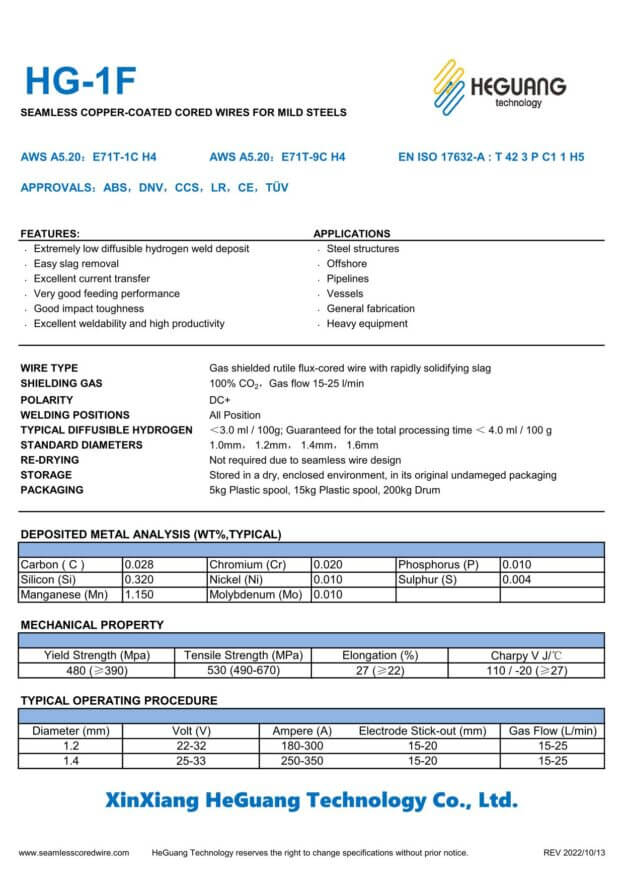
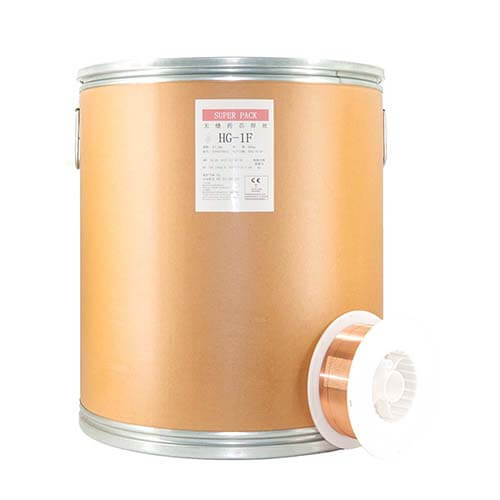
HG-1F / E71T-1C Seamless Flux Cored Wire, Challenging the limits of low hydrogen

Within FCAW , seamless cored wires offer optimal protection against moisture reabsorption.

During use, moisture cannot penetrate into the filling since there is no closed seam running over the wire length. This extremely low level of diffusible hydrogen prevents the weld from hydrogen induced cracking or cold cracking.

HG-1F / E71T-1C is a seamless rutile flux cored wire applicable for all-positional welding with
100% CO2 shielding gas.

Thanks to its unique seamless structure, HG-1F / E71T-1C generates low spatter and has excellent impact properties in low temperature.
These properties make HG-1F / E71T-1C the perfect seamless cored wire for industries such as shipbuilding, steel construction, bridges, offshore, pipes, and pressure vessels.

Features & Benefit

  • Optimal protection against hydrogen induced cracking, due to ultra-low diffusible hydrogen content (under 3ml/100g weld metal)
  • Stable welding arc with low spatter and perfect weld bead
  • Good weldability in all positions and less post-weld cleaning
  • Unique seamless structure allow excellent feedability and electrical conductivity
  • Use 100% CO2 shielding gas
  • Excellent impact properties in low temperature, down to -30°C (-20°F) in pure CO2 gas


HF-55M / E81T1-Ni1M Flux Cored Wire

AWS A5.29 E81T1-Ni1M-J Flux Cored Wire Manufacturer and Supplier

HeGuang Technology is a high-tech company dedicated to develop and manufacture Seamless Flux-Cored Wires and Seamless Metal-Cored Welding Wires for shipbuilding, offshore, pipeline, bridge fabrication, structural steel fabrication and other industries. We are China’s AWS A5.29 E81T1-Ni1M-J flux cored wire manufacturer and supplier.

A5.29 E81T1-Ni1M-J is a type of flux-cored wire used for welding. The designation “A5.29” refers to the American Welding Society (AWS) specification for low-alloy steel electrodes for flux-cored arc welding. The “E” in the designation indicates that it is an electrode, and the “81” indicates the minimum tensile strength of the weld metal in ksi (thousands of pounds per square inch).

The “T1” indicates that the electrode has a rutile (titanium dioxide) flux, which provides good weld bead shape and slag release. The “Ni1M” indicates that the wire has a nominal composition of 1% nickel and 0.5% molybdenum, which provides good toughness and resistance to cracking in the weld metal. The “J” at the end indicates that the wire meets the impact toughness requirements when tested at -40°C.

Flux-cored wire is a type of welding wire that contains a flux core, which provides shielding from the atmosphere during the welding process. This allows for welding in outdoor or windy conditions, where solid wire and gas shielding may not be practical. Flux-cored wire is also often used for welding thicker materials, as it can provide deeper penetration than solid wire.

HM-50 / E70C-6M Metal-Cored Wire

What is AWS A5.18 E70C-6M metal cored wire?

AWS A5.18 E70C-6M is a type of metal cored wire used for welding. Metal cored wires are similar to flux-cored wires in that they have a tubular design, but instead of a flux coating, they have a metal powder filling. This metal powder filling contains various alloys and other materials that help to improve the welding process.

This type of wire is commonly used for welding carbon and low-alloy steels, especially in applications where high productivity and good penetration are desired. The metal powder filling helps to increase the deposition rate, resulting in faster welding speeds and higher productivity. The wire also produces a smooth, low spatter weld with good bead appearance.

AWS A5.18 A5.18M-2021

AWS A5.18 E70C-6M is a type of welding wire that conforms to the American Welding Society (AWS) specification A5.18. The “E70C-6M” designation indicates the specific type of wire, where “E” stands for electrode, “70” refers to the minimum tensile strength of the weld metal, “C” indicates that it is a composite electrode (i.e., metal-cored wire), “6” refers to Chemical Composition Requirements for Weld Metal from Composite Electrodes, and the “M” means that it is suitable for welding with 75%–80% Ar/balance CO 2 (M21) gas.

HM-50 (E70C-6M )Seamless Metal Cored Wire Robotic Welding Video

Hardfacing welding

What is 14700 : T Fe8 seamless flux cored wire for hardfacing?

Seamless flux-cored wire for hardfacing is a type of welding wire used to create wear-resistant coatings on metal parts. Hardfacing is a process in which a layer of wear-resistant material is applied to a metal surface to increase its durability and lifespan.

HD-60M Hardfacing

Seamless flux-cored wire for hardfacing is designed to be used in applications where a high degree of wear resistance is required, such as in mining, construction, and manufacturing industries. The seamless design of the wire allows for a consistent and uniform deposit of the welding material, resulting in a smooth and uniform surface finish.

The flux in the wire provides shielding from the atmosphere and produces a slag that covers the weld, protecting it from contamination. The hardfacing material is typically made of alloys such as chromium, tungsten carbide, or cobalt-based alloys, which are chosen for their high hardness and wear resistance.

It is important to use the correct type of hardfacing material and welding parameters when using seamless flux-cored wire for hardfacing to ensure a high-quality and long-lasting coating. The manufacturer’s instructions and recommended welding parameters should always be followed for optimal results.

What is ISO 14700 standard?

ISO 14700 is a standard developed by the International Organization for Standardization (ISO) that specifies requirements for the deposition of metallic and other inorganic coatings on metallic substrates by various thermal spray processes. This standard covers the following thermal spray processes:

  • Flame spraying
  • Electric arc spraying
  • Plasma spraying
  • High-velocity oxy-fuel spraying (HVOF)

ISO 14700 provides guidelines for the selection of coating materials and their properties, the preparation of substrates, and the control of the thermal spray process. It also covers the testing and evaluation of coatings to ensure that they meet the required quality and performance standards.

The purpose of this standard is to ensure that thermal spray coatings are applied consistently and reliably to provide the required level of protection, such as wear resistance, corrosion protection, or thermal insulation. Compliance with ISO 14700 can help ensure that thermal spray coatings are of high quality and will perform as intended in their intended application.

ISO 14700 is widely recognized as a global standard for thermal spray coatings and is used by many industries, including aerospace, automotive, energy, and defense.

What is ISO 14700 : T Fe8 seamless flux cored wire?

ISO 14700 T Fe8 is a code that refers to a specific type of thermal spray coating material. The “T” in the code stands for “Thermal Spraying,” indicating that the material is intended for use in thermal spray processes, such as flame spraying, plasma spraying, or HVOF spraying.

The “Fe” in the code refers to the primary element in the coating material, which in this case is iron. The number “8” indicates the percentage of the primary element in the material, which in this case is 8%.

Therefore, ISO 14700 T Fe8 specifies a thermal spray coating material that contains 8% iron as the primary element. The specific properties of the coating material, such as its hardness, wear resistance, and corrosion resistance, will depend on the specific composition of the material and the thermal spray process used to apply it.

HG-1F / E71T-1C Seamless Flux Cored Wire

Different between AWS A5.20 E71T 1C welding wire and AWS A5.20 E71T 1M welding wire

What is AWS A5.20 E71T 1C welding wire?

AWS A5.20 E71T-1C is a type of flux-cored welding wire used for welding carbon steel. It is classified as an all-position welding wire, meaning it can be used for welding in any position, including overhead. The “E” in the name stands for electrode or filler metal, while “71” indicates a tensile strength of 71,000 psi. The “T” signifies that it is a tubular electrode, and the “1” indicates that it is an all-position welding wire. The “C” at the end of the classification designates that it has a Charpy V-notch impact toughness requirement at -30°C.

This type of welding wire is designed to be used with CO2 shielding gas, which provides good penetration and a stable arc. It is commonly used in industries such as shipbuilding, offshore oil and gas, and structural steel fabrication. AWS A5.20 E71T-1C welding wire provides excellent weld bead appearance, easy slag removal, and low spatter levels. It has a high deposition rate, which makes it ideal for welding thicker sections of metal.

As with any welding process, it is important to follow the manufacturer’s instructions and recommended welding parameters when using AWS A5.20 E71T-1C welding wire to ensure a high-quality and strong weld.

HF-1M / E71T-1M Flux Cored Wire

What is AWS A5.20 E71T 1M welding wire?

AWS A5.20 E71T-1M is a type of welding wire that is used in flux-cored arc welding (FCAW) processes. This welding wire is designed for welding mild and low-alloy steel, such as structural steel, sheet metal, and heavy equipment.

The “E71T-1M” designation indicates the wire’s characteristics, including its tensile strength, welding position, and shielding gas requirements. The “E” stands for electrode, the “71” indicates a minimum tensile strength of 71 ksi, and the “T” refers to the wire’s tubular shape. The “1” indicates that it can be used in all positions, and the “M” means that it is suitable for welding with a mixture of argon and CO2 gases.

This welding wire is often used in construction, shipbuilding, and other heavy fabrication applications. It offers excellent weldability, good mechanical properties, and high deposition rates, making it a popular choice among welders. Additionally, AWS A5.20 E71T-1M welding wire has a low spatter and a smooth arc, which helps to produce high-quality welds.

Different between AWS A5.20 E71T 1C welding wire and AWS A5.20 E71T 1M welding wire

The main difference between AWS A5.20 E71T-1C and AWS A5.20 E71T-1M welding wire is the classification and intended use.

AWS A5.20 E71T-1C welding wire is designed for welding carbon steel and is classified as an all-position welding wire. The “C” designation at the end of the classification means that it has a Charpy V-notch impact toughness requirement at -30°C.

On the other hand, AWS A5.20 E71T-1M welding wire is specifically designed for welding mild steel and low alloy steels. The “M” designation in the classification means that it has a lower diffusible hydrogen content than the “C” classification. This makes it ideal for applications where hydrogen-induced cracking is a concern.

Both types of welding wire are classified as flux-cored, meaning they have a hollow core filled with flux. The flux provides shielding from the atmosphere and produces a slag that covers the weld, protecting it from contamination.

It is important to note that both types of welding wire should be used in accordance with the manufacturer’s instructions and recommended welding parameters to ensure a high-quality and strong weld.